
Calgary Psychology. AI Is Changing Everything. Your Nervous System Is Still Human.
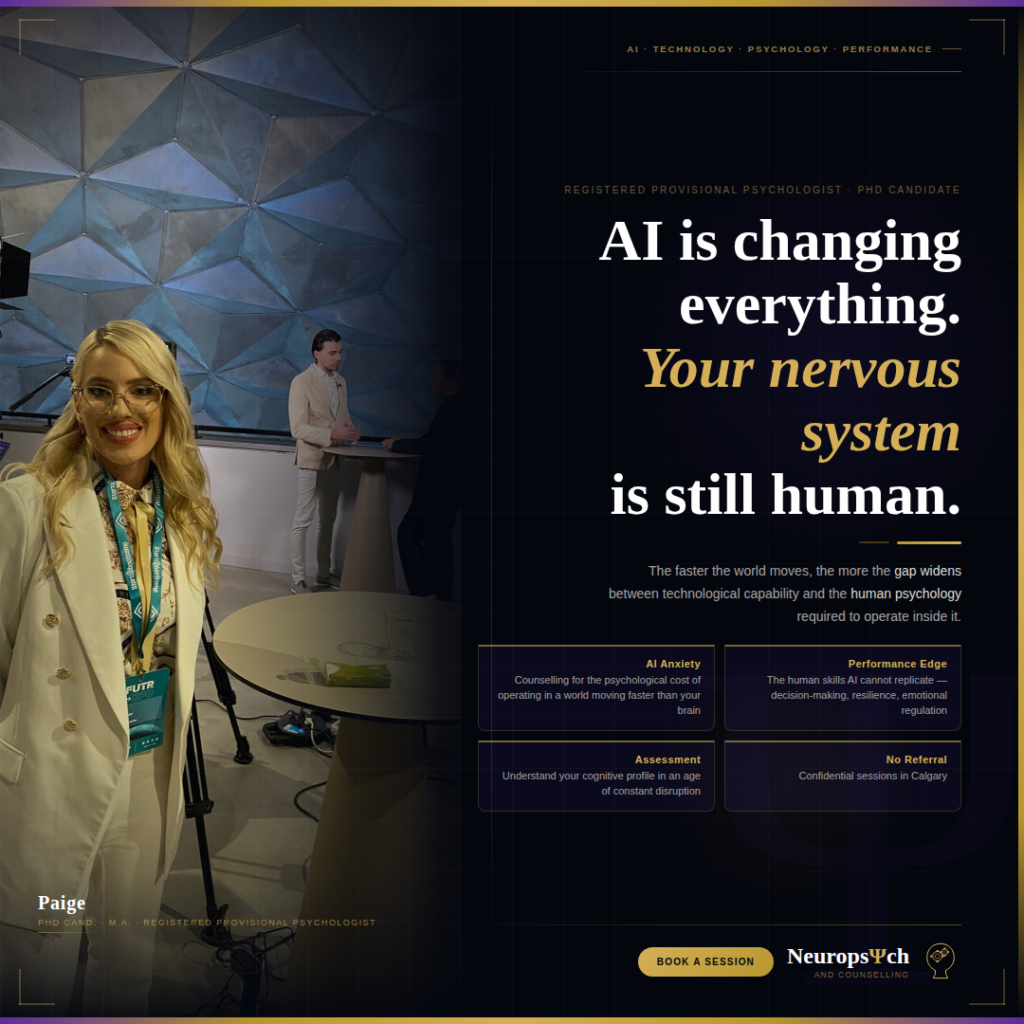
The Psychological Cost of Operating at the Speed of Artificial Intelligence and Why High Performers Are Paying It Without Knowing
I spoke at a technology expo last year in Europe. The room was full of founders, builders, and innovators — people who are, by every conventional measure, at the leading edge of what is happening in the world right now.
And almost every private conversation I had that day circled back to the same place.
Not the technology. The human cost of keeping up with it.
The disrupted sleep. The decision fatigue that arrives before noon. The low-level anxiety with no clear source — just a persistent sense that the world is moving faster than the ability to process it. The identity questions that nobody in the room was asking out loud: Am I still relevant? What happens if I fall behind? What is left of me if my skills become obsolete?
These are not productivity problems. They are psychological ones. And they are becoming more prevalent, more acute, and more clinically significant with every year that artificial intelligence accelerates into the environments where high performers work.
Your nervous system was not designed for this pace. And the gap between what technology demands and what human psychology can sustain is widening.
This blog is about that gap — and what to do about it.
What AI Is Actually Doing to the Human Nervous System
The psychological impact of artificial intelligence on working adults is no longer theoretical. The research is accumulating rapidly, and the findings are consistent.
Technostress — the specific psychological strain that arises from having to adapt to new technologies, manage the fear of obsolescence, and operate in environments of constant digital acceleration — is a significant predictor of both anxiety and depression. Recent research published in Frontiers in Psychology found that technostress explains nearly 12% of anxiety variability in working populations. That is a substantial effect for a single environmental factor.
The mechanism is straightforward and neurological. The human brain’s threat detection system — the amygdala — was designed for an environment of relatively predictable threats. It responds to uncertainty by activating the stress response: cortisol and adrenaline are released, attention narrows, the prefrontal cortex is partially inhibited.
AI creates a particular kind of sustained uncertainty. The rules change before you finish learning them. The skills that made you valuable last year may not be the skills that matter next year. The pace of change creates a chronic background hum of threat activation — one that never fully resolves because the threat itself never fully resolves.
The result is not a single moment of stress. It is a sustained activation of the stress response that, over time, produces exactly the cognitive and emotional symptoms that high performers report but rarely name as AI-related: difficulty concentrating, reduced creativity, decision fatigue, sleep disruption, a generalised anxiety that seems to have no single cause.
It has a cause. It is the mismatch between the speed of technological change and the pace at which human nervous systems can genuinely adapt to it.
The Specific Psychological Challenges of Operating in an AI Environment
For high performers — the exact population most immersed in AI-driven environments — several specific psychological challenges emerge consistently.
The obsolescence fear. Even among people whose roles are not directly threatened by AI, the question of relevance creates a persistent background anxiety. The fear of falling behind, of missing a development, of being the person in the room who doesn’t understand the technology everyone else is discussing — activates the same threat response as a genuine danger, even when the actual risk is low or manageable.
The identity disruption. For many high performers, their sense of self is deeply connected to their capability and expertise. When AI can produce in seconds what previously required hours or years of skill development, the psychological question beneath the productivity one is: Who am I if this is no longer difficult? That question does not have a simple answer, and it deserves more than a LinkedIn post about embracing disruption.
The always-on exhaustion. AI tools, available at all hours, remove the natural boundaries that previously governed work. The capacity to do more, at any time, creates a new kind of pressure — not the pressure to perform, but the pressure to never stop performing. The result is a chronic depletion that is difficult to name, because from the outside, everything looks like productivity.
The decision overload. AI creates more information, more options, and faster feedback loops. All of these increase the cognitive load on decision-making systems that were not designed for this volume. Decision fatigue — the documented deterioration in decision quality that comes from making too many decisions — is a genuine neurological phenomenon, and the AI-driven environment accelerates it significantly.
The disconnection from human experience. The more time spent in AI-mediated environments, the more attenuated the experience of the distinctly human dimensions of work: connection, meaning, creativity, the sense of being genuinely seen and valued. These are not minor losses. They are the psychological nutrients that make sustained high performance possible.
Why High Performers Are the Most Vulnerable
There is a counterintuitive pattern in who the AI-driven environment affects most severely.
It is not the people at the fringes of the technology. It is the people most immersed in it — the founders building AI products, the executives responsible for integrating it across their organisations, the professionals whose value proposition is increasingly defined by their ability to leverage it effectively.
These are also the people least likely to acknowledge the psychological cost of what they are experiencing. Because naming it feels like weakness. Because everyone around them appears to be managing. Because the professional culture they operate in treats psychological strain as a performance problem rather than a human reality.
And because, crucially, the symptoms of AI-driven psychological stress are difficult to distinguish from the symptoms of success. The exhaustion looks like dedication. The anxiety looks like drive. The sleep disruption looks like commitment. The identity uncertainty looks like strategic thinking about the future.
None of these reframings are false, exactly. They are just incomplete. And they prevent the person experiencing them from getting the support that would actually help.
The Human Skills That AI Cannot Replicate
Understanding the psychological cost of AI is one side of this conversation. The other is equally important.
There is a set of human capacities that artificial intelligence is structurally unable to replicate — and that become more valuable, not less, as AI automates more of the cognitive work that previously defined professional expertise.
Self-awareness. The capacity to accurately perceive your own emotional state, understand its influence on your thinking, and adjust your behaviour accordingly. No AI system has this. It is exclusively human, and it is the foundation of every meaningful leadership act.
Genuine emotional attunement. The ability to be fully present with another person’s experience — not to process signals and generate a response, but to actually understand what someone is feeling and why it matters. This is the basis of trust, and it cannot be automated.
Tolerance of ambiguity. The psychological capacity to sit with genuine uncertainty — not to resolve it prematurely, not to avoid it, but to remain functional and clear-thinking while the answer is genuinely unknown. AI optimises for resolution. The most important human decisions often require the courage to not know.
Meaning-making. The capacity to understand why the work matters, to connect effort to purpose, and to sustain motivation through difficulty in ways that are grounded in values rather than external reward. This is what makes performance sustainable across a career, rather than just a quarter.
These capacities are not soft skills. They are the hard differentiators of the AI era — and they are developed through exactly the kind of psychological work that most high performers have never prioritised.
What Psychological Support Looks Like in the Context of AI
Working with a registered psychologist who understands the intersection of technology, performance, and human psychology is not about managing symptoms. It is about building the specific capacities that allow you to operate effectively in an AI-driven environment without paying the compounding cost of doing so without support.
In practical terms, this means several things.
Understanding your specific stress architecture. Not generic stress management, but a precise picture of how your nervous system responds to the specific pressures of your environment — what activates the threat response, what sustains it, what actually regulates it.
Addressing the identity questions directly. The deep questions about relevance, capability, and worth that AI raises for high performers are psychological questions, not strategic ones. They require the space to be explored honestly, not resolved through productivity frameworks.
Developing sustainable performance patterns. Not optimisation tactics, but a genuine restructuring of how you engage with work, rest, and recovery in a way that accounts for the actual neurological demands of your environment.
Building the distinctly human capacities that AI cannot touch. Self-awareness, emotional attunement, resilience, meaning-making — the skills that become more valuable as AI becomes more capable, and that are developed through deliberate psychological work.
A Note on the Unique Position Calgary’s Tech and Business Community Occupies
Calgary is undergoing a rapid and significant transformation — from a resource-based economy to a diversified, technology-integrated business environment. The founders, executives, and professionals navigating that transformation are doing so in an environment of compressed uncertainty, accelerated change, and limited psychological support specifically designed for their context.
I founded Neuropsych and Counselling to serve exactly this population — the ambitious adult operating at the intersection of high performance and constant disruption, who deserves psychological support that understands both.
Take the First Step
If you are a founder, executive, or high-performing professional who is navigating the psychological weight of operating in an AI-driven environment — this is work I am specifically trained to support.
No referral required. Complete confidentiality. In-person in Calgary and virtually across Alberta.
Book a confidential consultation at www.neuropsychandcounselling.com
paige@neuropsychandcounselling.com