
High-Functioning Anxiety Calgary: Your Anxiety Isn’t a Personality Trait — It’s a Nervous System Stuck on High Alert
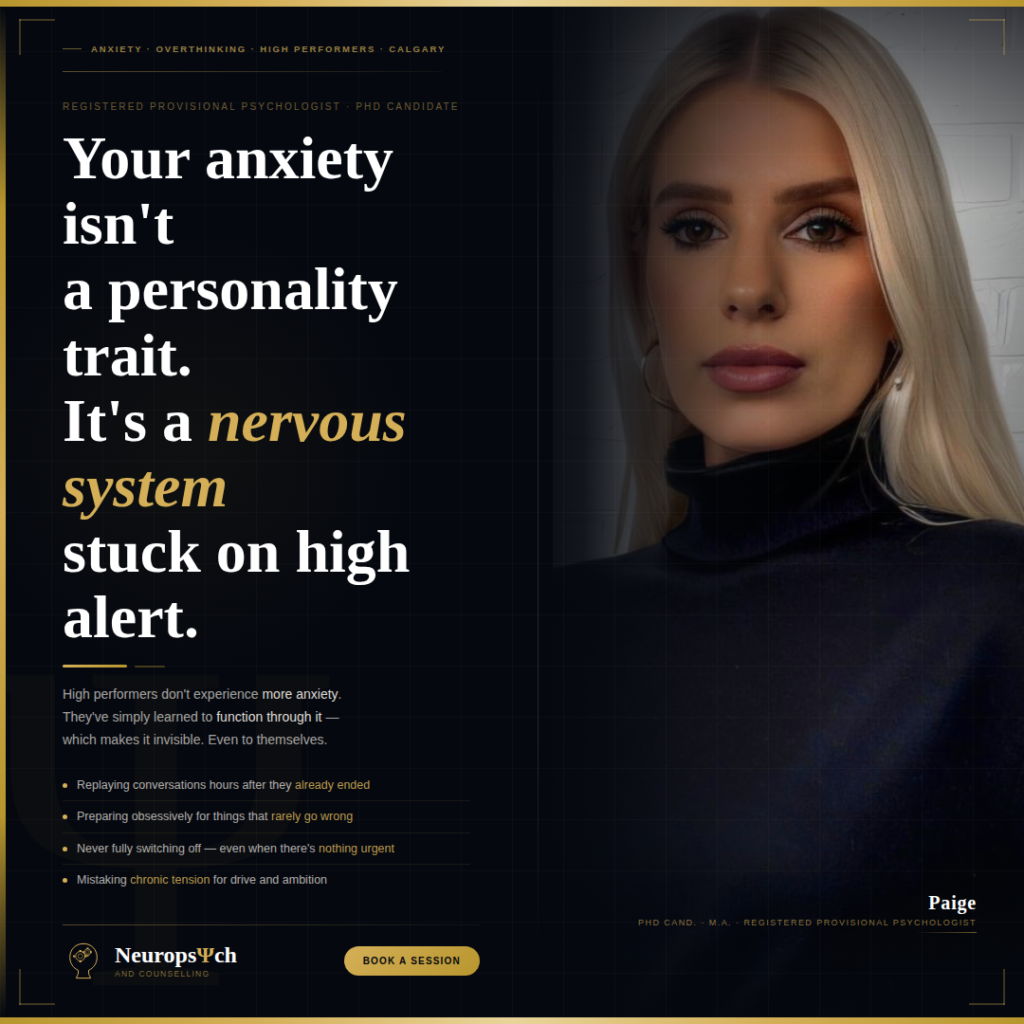
If you have ever described yourself as a worrier, a planner, an overthinker, or someone who just needs to be prepared — this blog is for you.
Not because those things are problems. But because for a significant number of high-achieving adults in Calgary, those descriptions are not personality traits. They are symptoms. And they have been quietly shaping your experience of every day, every relationship, and every high-stakes moment of your professional life — without ever being named for what they are.
High-functioning anxiety.
What High-Functioning Anxiety Actually Is
High-functioning anxiety is not an official clinical diagnosis. It is a widely used descriptor for adults who experience significant anxiety symptoms while continuing to perform well — or even exceptionally — in their professional and personal lives.
The defining feature is the gap between external presentation and internal experience.
From the outside, the person with high-functioning anxiety looks composed, capable, and in control. They arrive prepared. They anticipate problems before they happen. They maintain high standards and rarely miss a deadline.
From the inside, they are navigating constant worry, racing thoughts, pressure to perform, and difficulty relaxing. They may not have realised their experiences were related to anxiety because they were still functioning.
That gap — between how you appear and how you actually feel — is the central experience of high-functioning anxiety. And it is exhausting in a way that is very difficult to explain to anyone who hasn’t lived it.
The Neuroscience Behind It
High-functioning anxiety is not a character flaw. It is not weakness. It is not the price of ambition.
It is a nervous system that learned — at some point in your history — that staying on high alert kept you safe.
Your amygdala, the brain’s threat detection centre, is extraordinarily sensitive. When it perceives danger — real or anticipated — it activates the stress response: cortisol and adrenaline flood your system, your attention narrows, your prefrontal cortex (responsible for rational thinking and calm decision-making) goes offline.
This response is adaptive in genuine emergencies. It is designed to be temporary.
The problem arises when the threat detection system becomes chronically activated — when it learns that the world is a place where danger is always possible, and that vigilance is the only reliable protection. In that state, the brain never fully returns to baseline. The alarm never quite turns off. And the person living in that body learns to function around it — so effectively that eventually they stop noticing it’s there.
Until the cost becomes undeniable.
What It Looks Like in High Performers
High-functioning anxiety in achievers rarely looks like visible distress. It looks like this:
Replaying conversations long after they’ve ended. The meeting finished two hours ago. You are still analysing what you said, what they meant, and what you should have said differently. Not because anything went wrong. Because your brain won’t release it.
Obsessive preparation for things that rarely go wrong. You over-prepare. Always. Not because past experience tells you things will fail, but because the anxiety of under-preparing feels genuinely unbearable. The preparation is not productivity. It is relief-seeking.
The inability to genuinely rest. Holidays feel uncomfortable. Weekends generate a low-level guilt. Rest doesn’t restore you because your nervous system doesn’t know how to downregulate — it has been trained to treat inactivity as a threat.
Mistaking chronic tension for drive. This is the most insidious pattern. The underlying physiological tension — the tight chest, the shallow breathing, the constant low-level alertness — has been present for so long that it no longer registers as anxiety. It has been reframed as motivation, ambition, or simply who you are.
Perfectionism as a containment strategy. Perfectionism in high-functioning anxiety is not about standards. It is about control. If everything is done perfectly, the feared outcome cannot happen. It is an anxiety management strategy that happens to produce results — and at enormous cost.
Difficulty delegating or trusting others. Not because you are arrogant or controlling, but because your nervous system experiences loss of control as danger. Letting go feels like exposure.
Physical symptoms with no clear cause. Tension headaches. Jaw clenching. Chronic shoulder and neck tightness. Digestive sensitivity. Disrupted sleep — difficulty falling asleep, or waking at 3am with thoughts that won’t stop.
Why It Goes Unaddressed for So Long
Several specific factors make high-functioning anxiety particularly difficult to identify and address.
It doesn’t look like a problem from the outside. The standard picture of anxiety — someone visibly distressed, unable to function — doesn’t match. You are functioning. In many cases, you are excelling. This creates a powerful internal narrative that invalidates your own experience: “I can’t have anxiety. Look at everything I’m managing.”
It is frequently mistaken for positive traits. The diligence, the preparation, the attention to detail, the reluctance to let anything fall through the cracks — these are celebrated in professional environments. They produce results. Nobody questions them. Nobody asks what is driving them.
The coping strategies work — up to a point. High-functioning anxiety produces its own highly effective coping toolkit: planning, preparation, over-delivering, staying busy. These strategies genuinely reduce anxiety in the short term. They just also prevent the underlying nervous system pattern from ever being addressed.
Asking for help feels incompatible with the identity. The person who holds everything together, who never drops the ball, who is the most capable person in the room — asking for support feels like a contradiction. Or a betrayal of who they’ve been.
The Cost of Not Addressing It
High-functioning anxiety is not static. Without the right support, it tends to compound.
The coping strategies that worked in your twenties require more effort in your thirties. The capacity to manage the internal experience while maintaining external composure gradually depletes. What arrives — sometimes slowly, sometimes suddenly — is burnout, physical illness, relationship strain, or an anxiety that can no longer be contained by the usual tools.
The most common thing I hear from clients who finally come in is some version of: “I managed for years. And then I couldn’t anymore.”
The work of addressing high-functioning anxiety is not about becoming a different person. It is about understanding the nervous system pattern that has been driving your experience — and developing the capacity to actually regulate it, rather than simply manage around it.
What Treatment Actually Looks Like
Working with a registered psychologist on high-functioning anxiety is not simply learning relaxation techniques. It is a structured process of understanding and changing the underlying nervous system patterns that create the anxiety experience.
In practice, this involves several interconnected areas of work:
Understanding the origin of the pattern. Chronic threat detection doesn’t develop randomly. It develops in response to specific experiences — early environments where unpredictability was a feature, or where high performance was the primary source of safety, love, or belonging. Understanding the origin of your particular pattern changes the relationship you have with it.
Developing genuine nervous system regulation. Not stress management — that is managing the symptoms. Regulation means actually changing how your nervous system responds to perceived threat. This is possible, and it happens through specific, evidence-based approaches to working with the physiological dimension of anxiety.
Addressing the cognitive patterns. The catastrophic thinking, the overestimation of risk, the difficulty tolerating uncertainty that drives the preparation and the replaying. These patterns can be identified, understood, and changed.
Working with the identity. For many high achievers, the anxiety is so woven into their sense of self — their drive, their standards, their capability — that addressing it raises a genuine fear: who will I be without it? This question deserves real exploration, not dismissal.
Building sustainable performance. The goal is not to reduce your drive or your standards. It is to stop the drive being powered by fear — and to build a foundation for performance that is sustainable long-term, rather than perpetually running on the edge of depletion.
Anxiety Counselling in Calgary — Who This Is For
If you are a high-performing adult in Calgary who recognises the experience described in this blog — the chronic alertness, the inability to genuinely rest, the gap between how you appear and how you feel — this is work I am specifically trained to support.
I work with professionals, executives, founders, and high achievers who are ready to understand what has been driving their experience — and to develop a genuinely different relationship with their nervous system.
No referral required. All sessions are completely confidential. Available in person in Calgary and virtually across Alberta.
Take the First Step
Understanding your anxiety is not about becoming calmer. It is about finally having access to the version of yourself that isn’t permanently running on high alert.
Book a confidential consultation at www.neuropsychandcounselling.com
paige@neuropsychandcounselling.com