
Your Brain Is Your Most Valuable Performance Asset. Most High Performers Never Invest in It
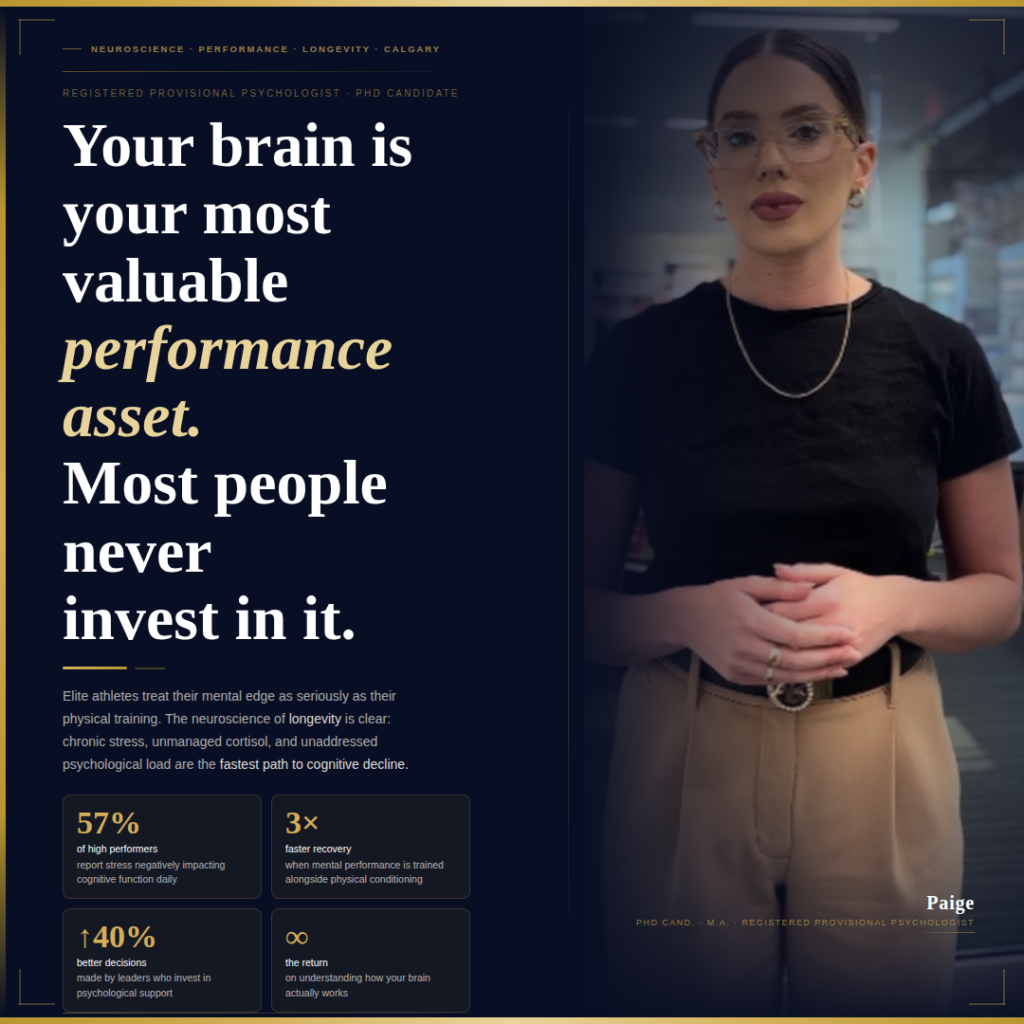
The Neuroscience of Longevity, Cognitive Performance, and Why Psychological Support Is the Highest-Leverage Investment a High Performer Can Make
You track your revenue. You monitor your physical performance. You optimise your sleep, your nutrition, your team, your systems.
But there is one asset that determines the quality of every single decision you make, every relationship you navigate, every insight you generate, and every year of productive life you have ahead of you — and most high performers have never once deliberately invested in it.
Their brain.
Not because they don’t care. Because nobody framed it this way before.
This is that framing.
The Most Important Finding in Brain Health Research Right Now
In a 10-year study conducted by Yale University, researchers found that rates of cognitive decline — including problems with memory, concentration, and decision-making — are rising sharply among working-age adults. The most surprising finding, published in the journal Neurology in 2025, was that the largest increase in cognitive decline is occurring among adults aged 18 to 39.
Not elderly adults. Not people with pre-existing neurological conditions.
High-achieving adults in the prime of their careers. People who look, by every external measure, like they are performing well.
The researchers identified several modifiable factors driving this trend — and at the centre of all of them was chronic psychological stress, unmanaged cortisol, and the accumulated load of operating under sustained pressure without adequate recovery or support.
In other words: the conditions that define high performance, when left unaddressed, are actively accelerating cognitive decline in the exact population that can least afford it.
What Your Brain Actually Does Under Chronic Stress
To understand why this matters, it helps to understand what chronic stress actually does to the brain at a neurological level — because it is significantly more consequential than most people realise.
Your stress response system is designed for acute threats. When your amygdala perceives danger, it triggers the release of cortisol and adrenaline — hormones that sharpen your attention, mobilise your energy, and prepare your body to respond. This is adaptive and essential. In the short term, the stress response is one of your greatest assets.
The problem arises when the stress response becomes chronic. When the demands of high performance keep your cortisol elevated not for minutes but for months and years.
At that point, the same system that was designed to protect you begins to compromise the most sophisticated cognitive architecture you own.
The prefrontal cortex — the seat of rational decision-making, emotional regulation, creative thinking, and long-term planning — is systematically impaired by chronic cortisol elevation. You lose access, gradually and often imperceptibly, to the very cognitive capacities that make you effective.
The hippocampus — the brain region most critical to memory formation, learning, and pattern recognition — is physically reduced in size by prolonged stress. This is not metaphorical. Chronic psychological stress measurably shrinks the hippocampus, with direct consequences for memory, learning speed, and cognitive flexibility.
Neuroinflammation increases with chronic stress, disrupting neural circuits involved in mood regulation, interoception, and cognitive function — and accelerating the biological ageing of the brain.
Neuroplasticity — the brain’s capacity to form new connections, adapt to new information, and recover from difficulty — is significantly reduced under chronic stress conditions.
The compounding effect of these changes, over years and decades, is not subtle. It is the single most significant modifiable determinant of both cognitive performance in the present and cognitive longevity into the future. And it responds directly to the right kind of psychological support.
The Performance Edge Elite Athletes Already Understand
Twenty years ago, a professional athlete who worked with a sports psychologist kept it quiet. The association with mental training carried an implicit suggestion of weakness — that something was wrong with your head.
In 2026, that stigma has inverted entirely at the elite level. Systematic mental performance training is now as standard as strength and conditioning in top sports programmes. Athletes who do not engage with it are increasingly at a structural disadvantage to those who do.
What changed is not the athletes. What changed is the science — and the willingness to apply it.
The mental training methods now used in elite sport are not vague or abstract. They are specific, evidence-based interventions designed to do measurable things to your brain: improve attentional control under pressure, reduce the cortisol response to high-stakes situations, increase psychological flexibility, build the kind of emotional regulation that allows sustained high performance without the compounding costs that chronic stress produces.
The executives and founders and high performers I work with in Calgary are operating under exactly the same level of psychological pressure as elite athletes. In many cases, more. The stakes are financial, relational, and reputational simultaneously. The seasons never end. There is no off-season, no pre-season, no recovery block built into the professional calendar.
Most of them are doing all of this without any systematic psychological support. Relying instead on willpower, discipline, and the hope that they are somehow constitutionally different from the research.
They are not. And neither are you.
Brain Health Is the New Longevity Frontier
The longevity conversation has exploded in the last several years — biohacking, supplementation, continuous glucose monitors, cold exposure, sleep optimisation, zone two cardio. These are all legitimate levers. Some of them are genuinely useful.
But the longevity literature is increasingly clear that the most powerful predictors of cognitive longevity — the ones that show up consistently across study after study — are not primarily biological. They are psychological.
A strong sense of purpose is one of the most powerful and underestimated predictors of longevity, with continued engagement in meaningful work associated with better cognitive resilience, cardiovascular health and overall longevity.
Social connection quality, not quantity, is a stronger predictor of cognitive resilience in later life than almost any lifestyle intervention currently being marketed as a longevity hack.
Psychological safety — the experience of having at least one relationship in which you do not have to perform — is directly correlated with reduced inflammatory markers and improved neuroplasticity across the lifespan.
And the management of chronic psychological stress — which requires not just lifestyle adjustment but genuine psychological understanding of why you are stressed, what is driving the stress response, and what it would take to actually change it — is the single highest-leverage intervention available to any high performer who is serious about the long game.
None of these outcomes are achievable through supplementation. They require actual psychological work.
What Neuropsychological Assessment Tells You That No Other Tool Can
If you are a high performer who is serious about your cognitive performance — present and future — a comprehensive neuropsychological assessment is the most useful single tool available to you.
Not a wearable. Not a cognitive training app. Not a self-assessment quiz.
A comprehensive neuropsychological assessment conducted by a registered psychologist maps your actual cognitive profile: your working memory capacity, your processing speed under load, your attentional regulation, your executive function, the specific patterns of strength and vulnerability that define how your brain performs under the conditions you actually live in.
It is, in the truest sense, a map. An accurate, clinically valid picture of the system that runs everything else in your life — and a clear framework for what support would actually move the needle.
Many of the high performers I assess are surprised by what emerges. Not because something is catastrophically wrong, but because the gap between how capable they appear and how their brain is actually performing is measurable, nameable, and — critically — addressable.
Understanding that gap changes everything. It transforms self-blame into self-knowledge. It turns vague underperformance into specific, addressable patterns. It gives you a foundation for working with your brain rather than pushing through it.
Counselling as Cognitive Investment
I want to reframe something that most high performers find counterintuitive.
Counselling — psychological support from a registered psychologist — is not primarily about managing distress. It is not a last resort. It is not a crisis intervention.
For high performers, it is a cognitive investment. The highest-leverage one available.
Every decision you make runs through your prefrontal cortex. Every relationship you navigate runs through your emotional regulation system. Every piece of creative work, strategic insight, or leadership action runs through a neural architecture that is either supported and maintained or progressively compromised by chronic stress.
Working with a psychologist who understands both the neuroscience of performance and the psychological dimensions of living under sustained pressure does something specific: it reduces the cognitive and emotional load that is quietly taxing your most important system. It builds the psychological flexibility and regulatory capacity that allow you to perform at a higher level for longer, with less cost to your health, your relationships, and your brain.
This is not the conversation the mental health field has historically been willing to have. But it is the conversation that the neuroscience demands — and it is the conversation I am trained and equipped to have with you.
Who This Is For
If you are a founder, executive, athlete, or high performer in Calgary who:
- Operates under sustained pressure and has never had systematic psychological support
- Is interested in optimising cognitive performance — present and future
- Wants to understand your own neuropsychological profile and what it means for how you work
- Has noticed that something is costing more than it used to, without being able to name exactly what
This is the work I do at Neuropsych and Counselling.
Not generic therapy. Neuropsychological assessment and performance-focused counselling — built specifically for people who understand that the brain is not a fixed asset, and who are ready to invest in it accordingly.
Take the First Step
The brain that has gotten you here is the same brain that will determine what you build next — and how long you can sustain it.
Book a confidential consultation at www.neuropsychandcounselling.com
paige@neuroupsychandcounselling.com